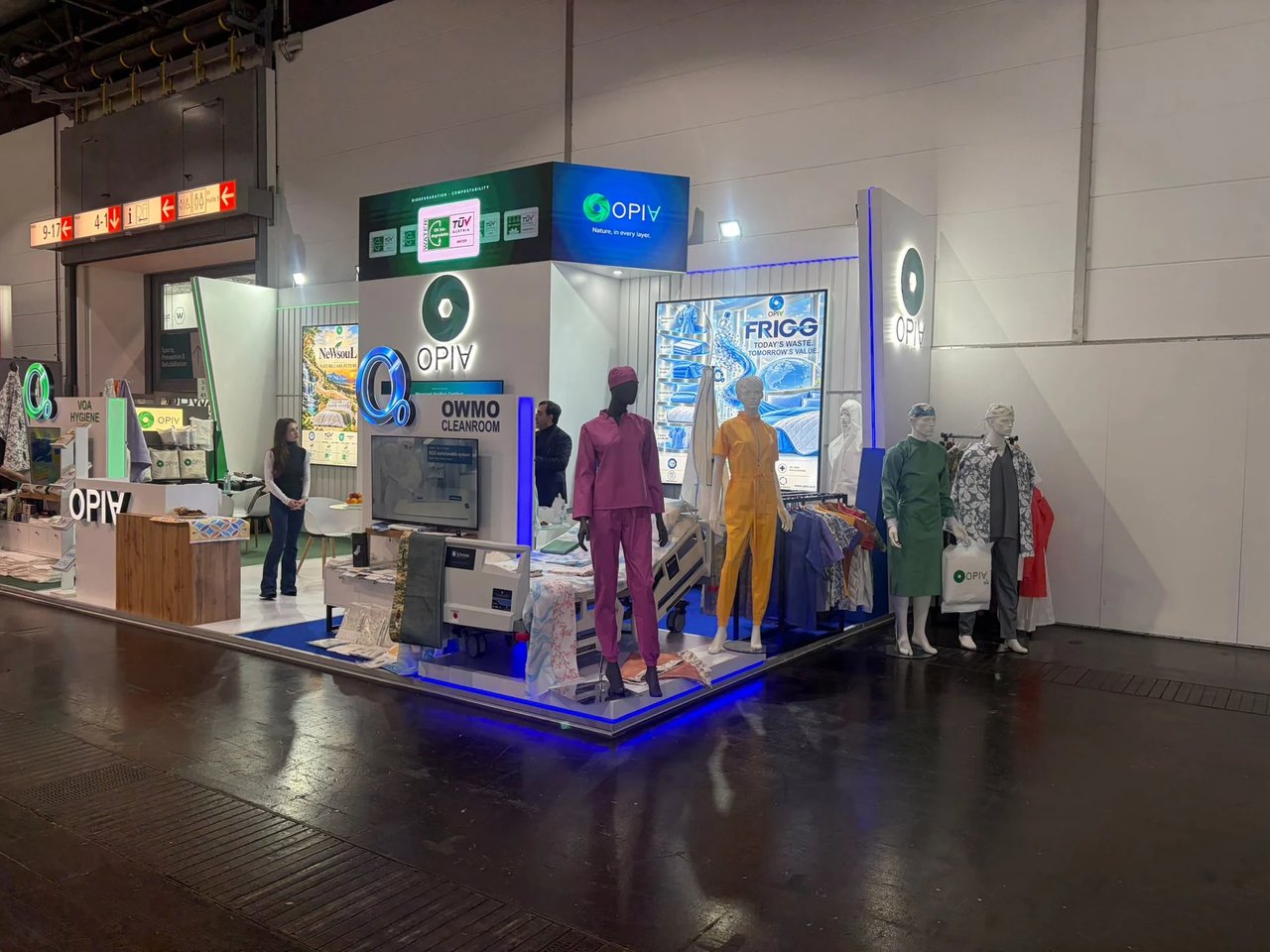


Sustainability in medical textiles cannot be explained solely by the fibre used in a gown, drape or patient care textile. A sound assessment considers intended use, required performance, production, transport, use and end of life together. Here, OPIA ECO presents a framework for health care facilities and procurement teams. Our recommendations are a synthesis of the cited sources, rather than a claim of clinical or environmental superiority for a particular product.
1. Start with the task the product must perform
A surgical barrier, a patient bedding textile and a wiping cloth for a controlled area require different purchasing specifications. Define the application, contact conditions, performance requirements and conformity documentation first. Environmental objectives should be considered alongside these requirements.
We recommend a shared needs assessment involving clinical staff, infection prevention, procurement and waste management. Product selection should aim to reduce unnecessary consumption and purchases that fail to meet the task. WHO's facility guidance connects resource use with sustainable procurement. [2]
2. Compare the service delivered
Comparisons based only on kilograms or individual items can mislead. Consider a common functional unit such as “1,000 uses under specified performance conditions”. This is an illustrative calculation unit, not a product lifetime claim.
Include raw materials, manufacturing losses, energy, packaging and transport, plus washing, drying, disinfection, sterilisation, lost items and waste treatment where relevant. ISO 14040 provides a framework for life cycle assessment. [4]
3. Single-use or reusable?
Vozzola and colleagues' surgical gown study found that reusable systems could deliver lower environmental impacts in the systems examined. [6] Its findings cannot be transferred directly to OPIA ECO products or every hospital.
For a local decision, we recommend collecting:
Validated conditions for use and care of the reusable product.
Actual completed uses and reasons for early retirement.
Laundry loads, energy sources, water consumption and transport distances.
Required quantities, packaging and waste routes for single-use products.
Evidence that required performance is maintained in both systems.
Do not assess a single-use product as suitable for reuse, or assume an undocumented cycle count for a reusable product.
4. OPIA ECO's two material routes
OPIA ECO's
Review fibre composition, layers, films or coatings, accessories and packaging together. Recycled content should be documented for the specific product; a natural fibre's characteristics should not automatically be attributed to the complete article.
5. Read the scope before comparing carbon figures
ISO 14067 addresses product carbon footprint quantification, rather than all environmental impacts. [5] Ask for the calculation unit, system boundary, data period and assumptions alongside the result.
A result covering raw materials and manufacturing alone should not be directly compared with one including use and disposal. A lower carbon figure does not itself establish lower water impacts, better clinical performance or verification of an entire product family.
6. Separate material properties from waste routes
WHO prioritises waste prevention and segregation at source. [1] A product's condition after use and local waste rules determine the available route.
“Bio-based”, “biodegradable” and “compostable” have different meanings, as the European Commission explains. [7] Compostability does not mean contaminated medical textiles can enter composting. Similarly, recovered PET content alone does not establish that the finished, used product can be recycled at a local facility.
7. A practical procurement roadmap
UNEP highlights the need for cooperation across the textile value chain. [3] Building on this framework, we recommend:
Define intended use and mandatory performance.
Measure current consumption, losses, packaging and waste.
Check product documents, composition and instructions.
Compare alternatives using the same function and system boundary.
Run a limited pilot in an appropriate setting, tracking safety, workflow, cost and resource use together.
Review the results and update purchasing specifications.
Evidence-based product assessment with OPIA ECO
Start a product discussion with OPIA ECO by sharing your application, expected performance and required documentation scope. Product-specific technical information and current document status should form part of the selection file. Our Compliance and trust and Sustainability pages provide starting points.
This article is a general research and procurement assessment. It does not establish equivalence between products examined in the literature and OPIA ECO products, or assume identical results.
Sources
WHO, Climate-resilient and environmentally sustainable health care facilities (2020)
UNEP, Sustainability and Circularity in the Textile Value Chain: A Global Roadmap (2023)
Vozzola, Overcash & Griffing (2020), AORN Journal, DOI: 10.1002/aorn.12885
European Commission, Bio-based, biodegradable and compostable plastics
Research and link review: 4 November 2026.